- Kingdom Alive
- Hits: 4623
NOTHING EQUALS NOTHING…
NOTHING PRODUCES NOTHING...
SOMETHING PRODUCES SOMETHING...
DIVINE EQUATION
NOTHING PRODUCES SOMETHING…
In these difficult days the book of Genesis (beginning) is taken as a collection of old legends that contain a little spiritual and moral themes, but with not much historical truth.
However, in the first eleven chapters of Genesis we can find that the scientific and historical information supports the word of God. (Bible).
The first verse of the Bible is the most basic and important..."In the beginning God created the heavens and the earth."
This verse demolishes many false theories about the origin of everything, invented by man.
Creation is simply the work of GOD bringing everything into existence. Everything in the universe has a beginning, only God is eternal. The translation of the old Hebrew testament by the translators of the Septuagint (Greek translation). [The term Septuagint, meaning “ seventy “, actually refers to the seventy and two translators (six from each tribe of Israel), involved in translating the Pentateuch from Hebrew to Greek in the third-century BCE (seventy-two is rounded down to seventy, hence the Roman numeral LXX )], is referred to as the book of origen or beginning.
In the beginning …tell us when the time began. The heavens …tell us about the vast expanses of space in the universe and the earth …tell us about the matter with would occupy space and time.
The primeval Programmer and His programmed purposes are found in the book of Beginnings, and shows us the origin of order, origin of the solar sistem, origen of time, origen of humanity,etc.
The Bible tell us that GOD created all things, then He controls all things and can do any thing.
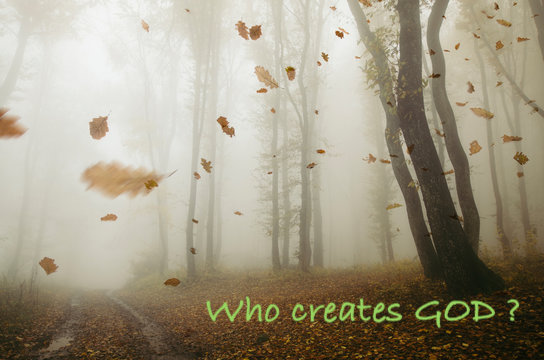
Making it clear that God made (brought into existence) everything, it is important to know where God came from, and/or who creates Him. God is typically understood as the supreme being, creator, and principal object of faith in monotheistic religions like Christianity, Judaism and Islam. God's name in the Hebrew Bible is represented by the Tetragrammaton YHWH, which is often pronounced as "Yahweh." In some translations, it is rendered as "Jehovah," but "Yahweh" is considered the more accurate pronunciation based on historical and linguistic evidence. The word, “the LORD” (all caps) is a translation of the Hebrew word יהוה (Yahweh). This is distinguished from “the Lord” (without small caps), which translates a different Hebrew word: אדון (adonai), meaning “lord” or “master".
Some people today, for some reasons, pronounce Yahweh as “Yah-way.” But the structure of Hebrew makes it possible to write the language without vowels, and the only letters we are certain of in the word are actually the four consonants: YHWH. So we don’t actually know how it was originally pronounced. This four-consonant spelling of the name of God is called the Tetragrammaton, which means “four letters” (Greek tetra-, “four”; grammaton, “letter”).
The Tetragrammaton does appear in some manuscripts of the Hebrew Bible.
- An after the fire came a gentle whisper. ( 1 Kings 19:12 NIV )
An example of the latter is the cosmological argument, which appeals to the notion of causation to conclude either that there is a first cause or that there is a necessary being from whom all contingent beings derive their existence. Other versions of this approach include the appeal to contingency—to the fact that whatever exists might not have existed and therefore calls for explanation—and the appeal to the principle of sufficient reason, which claims that for anything that exists there must be a sufficient reason why it exists.
The arguments by St. Thomas Aquinas known as the Five Ways—the argument from motion, from efficient causation, from contingency, from degrees of perfection, and from final causes or ends in nature—are generally regarded as cosmological. Something must be the first or prime mover, the first efficient cause, the necessary ground of contingent beings, the supreme perfection that imperfect beings approach, and the intelligent guide of natural things toward their ends. This, Aquinas said, is God. The most common criticism of the cosmological argument has been that the phenomenon that God’s existence supposedly accounts for does not in fact need to be explained.
According to a more recent version of the argument, known as intelligent design, biological organisms display a kind of complexity (“irreducible complexity”) that could not have come about through the gradual adaptation of their parts through natural selection; therefore, the argument concludes, such organisms must have been created in their present form by an intelligent designer. Other modern variants of the argument attempt to ground theistic belief in patterns of reasoning that are characteristic of the natural sciences, appealing to simplicity and economy of explanation of the order and regularity of the universe.
Perhaps the most sophisticated and challenging argument for the existence of God is the ontological argument, propounded by St. Anselm of Canterbury. According to Anselm, the concept of God as the most perfect being—a being greater than which none can be conceived—entails that God exists, because a being who was otherwise all perfect and who failed to exist would be less great than a being who was all perfect and who did exist. This argument has exercised an abiding fascination for philosophers; some contend that it attempts to “define” God into existence, while others continue to defend it and to develop new versions. It may be possible (or impossible) to prove the existence of God, but it may be unnecessary to do so in order for belief in God to be reasonable.
Perhaps the requirement of a proof is too stringent, and perhaps there are other ways of establishing God’s existence. Chief among these is the appeal to religious experience—a personal, direct acquaintance with God or an experience of God mediated through a religious tradition. Some forms of mysticism appeal to religious tradition to establish the significance and appropriateness of religious experiences. Interpretations of such experiences, however, typically cannot be independently verified.
Finally, Dr. William Lane Craig [ American analytic philosopher, Christian apologist, author, and theologian, with a doctorate in philosophy from the University of Birmingham in 1977 and a second doctorate in theology from the University of Munich in 1984 ], clarifies that the first premise of the cosmological argument is not that everything has a cause. In that case, God would need a cause. The premise is: “Everything that begins to exist has a cause.” That is, if something begins to exist at some point in time, then there must be something that brought it into existence; it cannot simply arise without any cause, from nothing. But if a Being is eternal, that it never began to exist, but has always existed, then it is difficult to see how such a Being could have a cause, since there is nothing prior to it. So the idea about God has always been that of an eternal, self-existent being, who never began to exist. Therefore, the question of what is the cause of God is a meaningless question; it is like asking, “Why aren’t all the single people married?” God cannot have a cause, being an eternal and self-existent Being.
We show the evidence, the final decision is yours.
…
TODAY
Our objective is not to explain what is currently happening in the world, as there are many individuals and organizations dedicated to reporting on daily events, but rather to show the greatness of the Creator, our Heavenly Father, who lives eternally.
TO THOSE
… who seek to destroy my faith and the work of my hands—even when I am doing my absolute best to showcase the wonders of God—I offer the words of King David… .… “ they have rewarded me evil for good, And hatred for my love. Set thou a wicked man over him: And let satan stand at his right hand. When he shall be judged, let him be condemned: And let his prayer become sin. Let his days be few; And let another take his office. Let his children be fatherless, And his wife a widow. Let his children be continually vagabonds, and beg: Let them seek their bread also out of their desolate places. Let the extortioner catch all that he hath; And let the strangers spoil his labour. Let there be none to extend mercy unto him: Neither let there be any to favour his fatherless children. Let his posterity be cut off; And in the generation following let their name be blotted out. Let the iniquity of his fathers be remembered with the LORD; And let not the sin of his mother be blotted out. Let them be before the LORD continually, That he may cut off the memory of them from the earth. Because that he remembered not to shew mercy, But persecuted the poor and needy man, That he might even slay the broken in heart. As he loved cursing, so let it come unto him: As he delighted not in blessing, so let it be far from him. As he clothed himself with cursing like as with his garment, So let it come into his bowels like water, and like oil into his bones. Let it be unto him as the garment which covereth him, And for a girdle wherewith he is girded continually. Let this be the reward of mine adversaries from the LORD, And of them that speak evil against my soul. “
PSALM 109